
Which hernias are common in women?
- Navel (umbilical) hernia, often appearing or enlarging after pregnancy
- Groin hernias: inguinal hernia is still the most common type, but femoral hernia is much more common in women than in men
- Hernia after caesarean section or other abdominal operations, at the scar
- Diastasis recti (separated tummy muscles), with or without a hernia
Why does groin pain or a groin lump need prompt assessment in women?
A femoral hernia sits just below the groin crease and is easily missed or mistaken for a lymph node. It has a higher risk of trapping bowel than an inguinal hernia, so it is repaired promptly once found.
For groin hernias in women, the international HerniaSurge guideline suggests laparoscopic repair. It allows the surgeon to check and repair both the inguinal and femoral openings, including a femoral hernia that was not felt on examination. During pregnancy, swollen veins along the round ligament can mimic a groin hernia; ultrasound helps tell them apart, and they usually settle after delivery.
What is diastasis recti?
Diastasis recti is a widening and thinning of the band between the two rectus (six-pack) muscles. The European Hernia Society defines it as a gap wider than 2 cm. It is common during and after pregnancy and often improves over the first months after delivery.
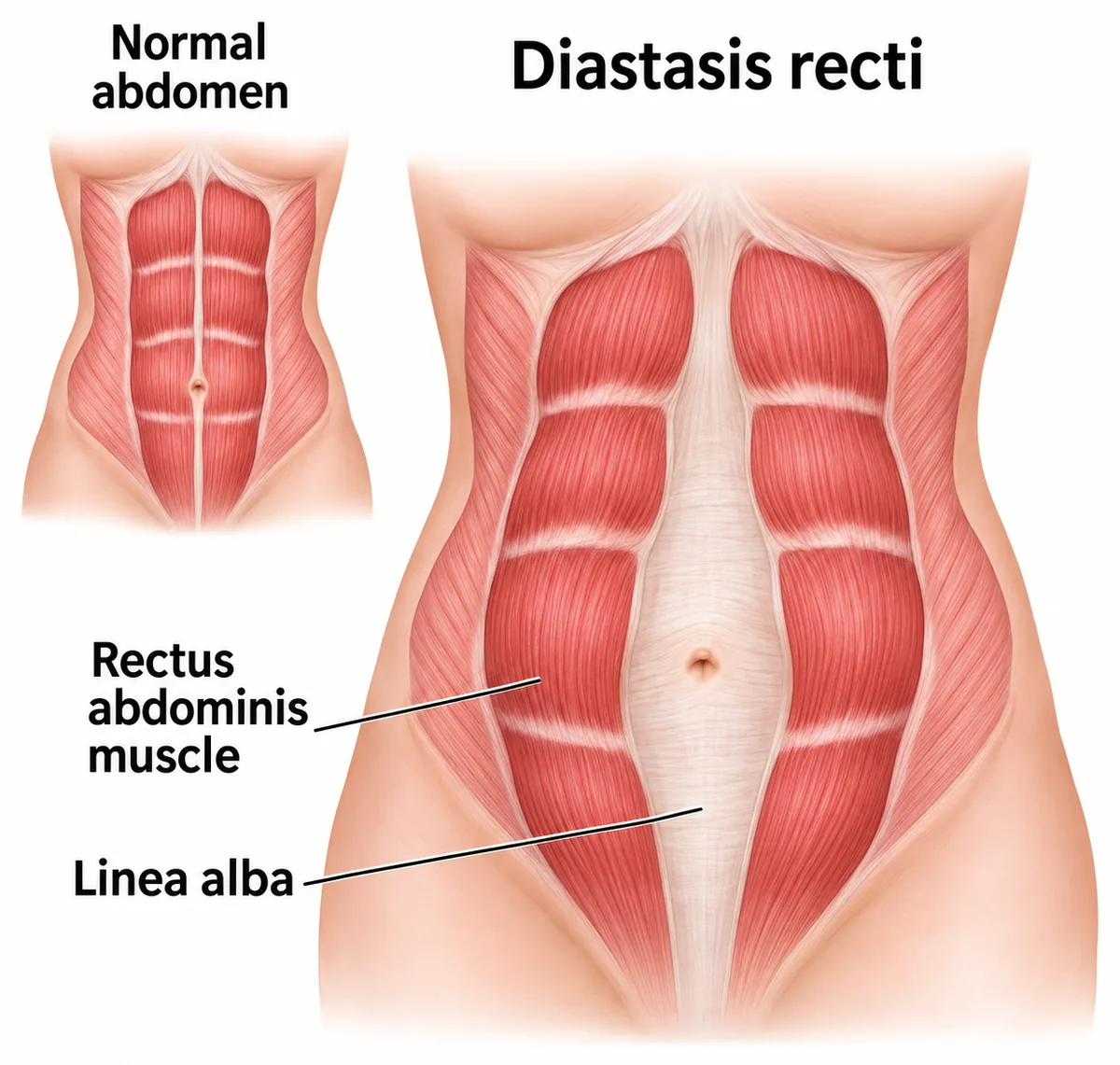
It is not a hernia, because there is no hole in the abdominal wall, but a hernia at the navel or above it often occurs alongside it. Symptoms include a midline bulge or ridge when sitting up, a feeling of core weakness and back discomfort.
Guided core rehabilitation with a physiotherapist is the first treatment. Surgery is considered when troublesome symptoms persist despite rehabilitation, or when there is an associated hernia, usually once you have recovered from pregnancy and do not plan further pregnancies. If loose skin is the main concern, abdominoplasty with a plastic surgeon may be the right route.
Should a hernia be repaired before or after another pregnancy?
A later pregnancy increases the chance of a hernia coming back. Guidelines from the European and Americas Hernia Societies therefore suggest postponing repair of a small, symptom-free umbilical hernia until after your last pregnancy.
A hernia that is painful, growing or difficult to push back is repaired whatever your plans, because waiting carries more risk. A hernia found during pregnancy is usually watched and repaired after delivery, unless it becomes trapped and needs emergency surgery.
How are these hernias repaired, and what are the risks?
Small navel hernias are usually repaired through a small cut, with a flat mesh behind the muscle for defects around 1 cm or larger. When diastasis recti and a hernia occur together, the muscles can be brought together (plication) and reinforced with mesh by open, laparoscopic, robotic or endoscopic techniques. Groin hernias are usually repaired laparoscopically or robotically. Hernias at a caesarean scar are covered in hernia after surgery.
Risks include fluid collection (seroma), bruising, wound infection, persistent discomfort and recurrence. The choice of technique depends on the size of the gap, the hernia, your skin and your plans for pregnancy.
Recovery after repair
Most women walk the same day and go home the same day or the next. Return to desk work is often within one to two weeks, longer after a diastasis repair. Lifting small children and heavy household work are built up gradually, and timing is agreed before surgery so that help at home can be arranged.
When to seek urgent care
Seek emergency care for a groin or navel lump that becomes suddenly painful, tense or impossible to push back, especially with vomiting, a swollen abdomen or inability to pass stool or wind.
Already advised an operation? Bring your reports for a surgical second opinion.